
Why CRCL Can Be Used by an Ob-Gyn in Chicago and a Midwife in Nairobi

Updated: Aug 10
At a clinic in Chicago, it’s usually an Ob-Gyn who treats cervical precancer (when abnormal cells appear on the surface of the opening of the uterus). In Kenya, where there are approximately 500 Ob-Gyns in the entire country, a nurse or midwife treats it, if it gets treated at all. At Ananya Health, we’re building one device for both of them.
Sounds simple, right? Unfortunately, in almost every standard treatment for cervical precancer, the tool decides who can use it and where.
In the U.S., there are a few proven ways to treat cervical precancer. The most widely used by Ob-Gyns is called loop electrosurgical excision procedure (LEEP), which uses a thin electrified wire loop to remove affected tissue. LEEP is usually done in the office under local anesthesia, but it has to be performed by a doctor specifically trained in electrosurgical techniques, and requires equipment many clinics do not have. For some women, that means having this procedure performed in a hospital or a surgical center instead, costing them more time and money.
Ablation, which uses extreme cold or heat to freeze or burn abnormal cells, has historically been a simpler, more accessible (and lower-cost) option. Unlike LEEP, cryoablation needs no anesthesia because the cold numbs the tissue as it works. But it depends on a steady supply of bulky cryogenic gas tanks, stored upright and chained to the wall so they don’t topple over, refilled at a specialized facility, and delivered by a vendor. Most clinics would rather refer patients out than forecast the needed cryogen, build dedicated gas-handling infrastructure, and contract a vendor to collect, refill, and replace tanks for a single procedure. I have seen clinics abroad that stopped screening women altogether because they couldn’t reliably get gas tanks in case those women screened positive.
In a lot of low-resource settings, the workaround has been thermal ablation. Thermal ablation uses heat instead of cold and needs no tanks. Heat is far easier to engineer than cold, so thermal spread where gas-based cryo couldn't follow. Cryo is the more established modality, with more and stronger clinical data backing its use over decades, but for many clinics, thermal is the only ablation tool they can realistically keep running.
“From a public health perspective…having to have liquid nitrogen and CO2 moving around in the rural community can be challenging,” Dr. Chinedu Obikili, a clinician in Abuja, Nigeria, told us in 2025. “I feel like any technology or innovation that is trying to have simpler ways that [are] more accessible to people is very welcome.”
When we first set out to build Ananya Health’s cryoablation device six years ago, our team knew we had to design those requirements out, because each one represents a reason that a woman falls out of care.
How we built a device that breaks down barriers to care
First, we designed a system that removes the gas tanks entirely. Our device is a closed-loop system that uses no consumable cryogenic gas, so there’s nothing to store, forecast, refill, or wait on. It freezes and destroys precancerous cells the way cryotherapy always has, at a fraction of the cost of a consumable-gas-based system. It’s a powerful idea, but not an easy one. Six years of engineering and three Section 608 Small Refrigeration Licenses later, I’m reminded that the idea is just the start— the point at which the real work begins. Refrigeration is as much an art as a science, and we’ve learned a lot along the way as we’ve iterated through dozens of configurations.
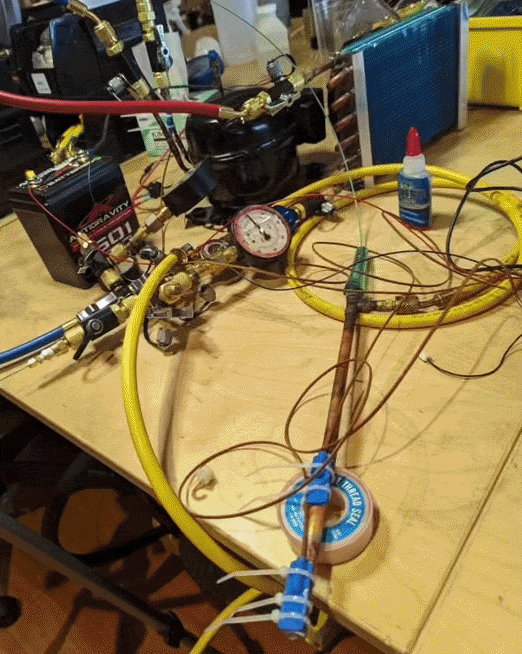
Power was another constraint we designed around. In a lot of the clinics where I worked in West Africa, the electricity was unreliable, and plenty of donated machines died the first time the power failed. We built ours to run on a rechargeable battery and on wheels, so it could be charged when power is available and used when it isn’t. That is also what lets it work in the same exam room where a woman is screened, by the provider already standing there, instead of being tied to a wall outlet, a gas line, or a vendor delivery.
That last part is the one I care about most. Because the device is straightforward to operate, any clinician who already performs a pelvic exam can be trained to use it, whether that’s an Ob-Gyn or a nurse practitioner.
This is what it means to let a provider work at the top of their license, doing everything their training allows instead of sending a patient up the chain. A midwife who already sees a woman for her Pap can treat abnormal findings at the same visit, in the same room. For the patient, that means staying with someone she knows, at a lower cost, instead of paying more to be handed off to a stranger somewhere else.
Closing the gaps between early detection and treatment
Whether she lives in Chicago or Nairobi, when a woman screens positive for abnormal cells on her cervix and her clinic cannot treat her, she usually gets a referral to a specialist. That referral means a second appointment, travel, time off work, another day built around a procedure that takes about 20 minutes. At every one of those steps, some women do not make it to the next.
In the U.S., an estimated 40% of women who screen positive for cervical precancer never complete treatment, and in some groups, it is even higher. These women are not careless. The system simply asks too much of them between the diagnosis and the treatment.
Eliminating cervical cancer depends on treating the vast majority of women who screen positive, and that does not work if specialists are the only ones who can do it. There will never be enough specialists in the places that need them most, here or abroad. The only way to reach that goal is to solve follow-up and widen who can deliver the treatment.
The market case for our device follows from the same choices. Nearly half of U.S. counties do not have a single Ob-Gyn, and the country is projected to lose thousands more over the next decade. A device that a generalist physician, a nurse practitioner, or a midwife can use reliably, consistently, and easily reaches them instead.
In the U.S., there’s already a billing code for cervical cryoablation, so using our device, a clinic can perform a 20-minute procedure with staff it already employs and be reimbursed about $150. This can also free up Ob-Gyns and primary care doctors to spend their time on more complex procedures and diagnoses. The choice that widens access is the same choice that builds the business.
None of this is about telling a doctor how to practice. A clinic that wants to do LEEP should do LEEP. We are adding an option where, for a lot of women, there currently is none, and putting it in the room where they already are.
I think about the woman who screens positive and then has to decide whether a second appointment, a day off, and a long drive are worth it. For too many women, the answer is no, and that decision can cost them their life over something we have known how to treat for decades. We're building this device so she never has to make that decision.
If you're interested in joining us on the journey to end cervical cancer in our lifetimes, we’d love to hear from you: invest@ananya.health

