Cervical Cancer Is Preventable. Why Does It Still Kill 350,000 Women a Year?

Originally posted to LinkedIn.
Cervical cancer is one of the most preventable and treatable cancers there is. But by the World Health Organization's (WHO) count, around 350,000 women still die of it every year, making it the fourth-most lethal cancer for women worldwide.
The unacceptable distance between those two facts is why we founded Ananya Health six years ago today.
Cervical cancer is not a disease that’s waiting for a cure. We understand the root causes and can prevent the vast majority of all cases, and we can treat it effectively before it becomes malignant cancer. In the U.S., diagnoses have fallen by more than half since the 1970s, mostly because of widespread screening. We solved the hardest parts of cervical cancer a long time ago. What we still haven't solved is access.
Ananya Health’s closed-loop cryoablation device is designed to tackle the specific moment in the care continuum gap where 40% of women drop out: when a woman screens positive for cervical precancer (or dysplasia) and then doesn't get treated. Not because the treatment is difficult or unproven, but because the clinic that screened her doesn’t have the tools or the staff to perform it, and so she needs to be referred somewhere else. Whether a woman lives in Mexico or in rural Mississippi, Ananya Health exists to make sure she can get that treatment immediately and seamlessly.
Cost isn’t “the” problem; cost is table stakes
I started my career in medical device design and public health while I was still a senior at Georgia Tech doing research on device design for emerging markets and interning at Transcardiac Therapeutics. The juxtaposition of designing cardiac ablation mesh and transapical access ports and identifying the design parameters that make medical technology available in emerging markets, has stuck with me throughout my career. After spending the next five years at C. R. Bard, a global medical device maker, I worked in Nigeria, running data and field operations for polio eradication and other public health programs across several African countries. I spent a lot of time inside clinics, and almost every one of them had the same equipment graveyard: a room of donated machines that couldn’t function in the hot or dusty climate, IV pumps that nobody had parts to fix, vaccine fridges that had blown all the building’s fuses, or a dialysis machine with no filters in sight.
The lesson most people take from that room is that poor countries cannot afford good equipment. That is the wrong lesson. Cost is a real constraint, but the machines in those rooms weren’t particularly expensive. They were designed for somewhere else, by people who never considered the patients or doctors in that clinic, and so they failed.

The gap between screening and treatment
That cervical cancer case rates persist is the same failure, scaled up to a whole disease. Using cold temperatures to destroy precancerous cells before they ever turn into cancer is not exotic or new. Cryoablation has been a standard-of-care treatment option for years, recommended by international clinical organizations and the WHO. It does not need an operating room and can be done the same day a woman is diagnosed with precancerous lesions. It doesn’t require anesthesia because the cold numbs the tissue as it works. Treated early, precancer almost never becomes cancer. Left alone, a share of those lesions will turn into malignant cancer.
Preventative treatment is not the hard part. Getting it to the patient is.
You can watch a woman fall out of care almost anywhere. In a low- or middle-income country, where the overwhelming majority of cervical cancer deaths happen, she can’t get treatment anywhere nearby. In the U.S., the gap is smaller, but the result is the same. When a woman goes in for a Pap smear (a routine cervical cancer screening) and the results come back abnormal, her doctor will make a referral to a specialist who might be a county or two away. Adding another appointment, more time off work, and more travel means that at every step, women drop out, until a large share never make it to a procedure that takes 20 minutes. The system just puts too many steps between the diagnosis and the proven treatment.
In 2018, the WHO called on countries to eliminate cervical cancer by increasing vaccination, screening, and treatment. I had just returned from Nigeria, where I spent three years watching what a declaration like that does on the ground, how it reorders national budgets and pulls a whole ecosystem of partners in one direction. A quote from surgeon and New York Times best-selling author Dr. Atul Gawande’s book Better that I often shared with our polio teams at eHealth Africa kept running through my mind:
“[A]lthough erasing the disease from the world is a grand, perhaps even absurd ambition, it remains a feasible task and one of the few things we as a civilization can do that would benefit mankind forever.”
Screening keeps improving, with self-collection, point-of-care testing, AI-based colposcopy, and other new tools coming out every year. But innovations in early treatment have not kept up. We are getting very good at telling a woman she has precancer, and no better at helping her do something about it.
Designing for where patients actually live
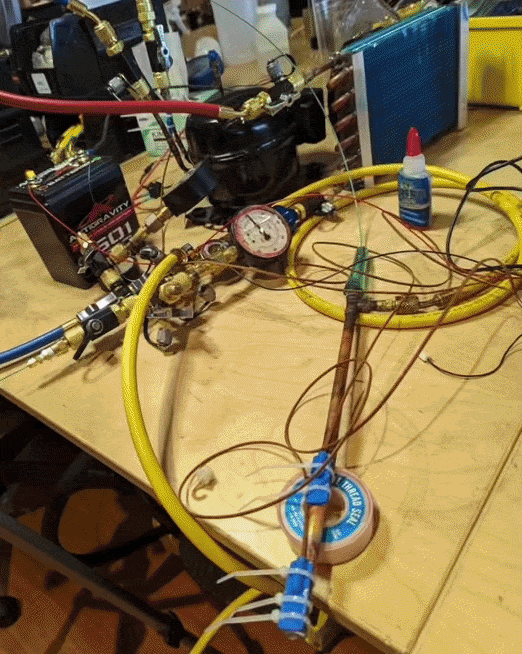
We built Ananya Health to close that gap. We’re developing a battery-powered cryoablation device that freezes and destroys abnormal cells on the cervix at the point of diagnosis, potentially in a single visit. Because it doesn’t require tanks of compressed gas, anesthesia, or an operating room, it can be used in the same doctor’s office where a woman was screened. And because we designed it to be simple to operate, any doctor or advanced nurse who performs a pelvic exam can be trained to use it.
As an engineer, I’m wired to see how access gaps are actually design problems. If women keep falling out of care between screening and the treatment, then those should not be two separate trips—so we built for one. A clinic that doesn’t have a vendor to deliver compressed gas needs a device that does not depend on one. And when the nearest specialist is hours away, the tool has to work in the hands of the clinician who is already in the room, who has already started the conversation and built trust. Access has to be a part of the specification from the start, not something we bolt on at the end.
The need is enormous, and it’s durable. About 25 million women will be diagnosed with precancerous cervical lesions each year. Over the next decade, as better screening tools identify more and more women with abnormal lesions, procedure growth is expected to grow by more than 300%. A market this large and this overlooked is not a niche, and it’s not a charity case. It’s an opening.
We think about the women who screen positive and never come back more than almost anything else. Not because their stories are unusual, but because they are so ordinary and so fixable. Cervical cancer has been preventable and treatable for a long time. Ananya Health's mission is to make sure this care reaches her.
If you're interested in joining us on the journey to end cervical cancer in our lifetimes, we’d love to hear from you: invest@ananya.health